Blog Archives
How to grow avocado profitably in Kenya.
This note is about avocado business strategy, and strategies do change from time to time. Let’s ride!
1. Location.
Remember the 3 C’s of location.
a) Clusters-this has to do with capacity that will encourage exporting firms to come buy your product. Unless you are doing large scale,it is important to join forces with other farmers to meet capacity.
b) Climate should be well suited for optimum production.
c) Clients. Who are your customers/market? How will your products reach them?
2. Plant right varieties.
Know what Your market wants and plant those.
3. Proper tree care and management .
-Irrigation.
-Fertilization.
-Crop protection.
-Thinning and pruning
– Harvesting

4. All year round production.
For You to have positive cash flow ensure all year round production. Plant a mix of early, mid and late fruiting seasons varieties.
5. You have to target both local and export market.
Hass, Fuerte and to some extent Pinkerton varieties are preferred for export market. Locally, size dictates the price. There are varieties that produce large size avocados of great taste that transports well, you need to plant those too.
6. Enrol on Etims @ kra
7. Consider branding Your products.
Using online and traditional marketing channels make Your brand standout and be the go to person for direct farm to plate organic avocados.
You as a farmer are the backbone of Your economy and the economy of our country. Planting is Caring, plant more !!!
Grafted Lemon Cultivation
Lemon is one of the important fruit among citrus fruits. This is a popular and well known fruit among Kenyans hence can be useful to you as a valuable cash crop and as a source of important nutrients. Lemon cultivation can be profitable to home gardeners and small scale farmers who have minimal land. 2-10 lemon trees if well taken care of is sufficient for you to be able to sell fruit in small quantities direct to neighboring consumers or in wholesale quantities to fruit vendors.

Location plays an important role when setting up your orchard. This entails climatic conditions of your area, exposure to sunlight, your soil type and also nearness to the market. Here are some of the factors you should consider when cultivating lemons:
- Climate
Tropic and subtropical regions are suitable for lemon cultivation. They are grown in both dry and humid atmospheres. Lemons thrive in arid and semi-arid areas as long as they receive sufficient water. Locations that are exposed to very low temperatures should be avoided because lemons are sensitive to cold. Temperature of 25-35°C is satisfactory for lemon growth. Excess temperature above 40°C might hamper growth.
- Soil
Lemons as most citrus trees grow well in a variety of soils. Avoid planting lemons in wet soils that are susceptible to waterlogging. Deep fertile well drained soil is suitable for optimum production. Soil PH between 6-7 is sufficient for lemons to thrive
- Propagation & planting
The common propagation method is from seed. Lemons can grow to maturity from seed but they take more years to start fruiting and will produce fruits highly variable in quality. For proper production ensure you plant one year old grafted lemon seedlings. Plant your seedlings at the beginning of the rainy season. A spacing of3- 5 metres between plants is ideal. Size of the hole will depend on your soil type; dig deeper holes if your land has a hard pan beneath the soil.
- Varieties
Ensure you grow a variety that grows and fruits well locally. We have five main varieties that we grow and proven their viability for both subsistence and commercial use.
- Genoa
- Lisbon
- Meyer
- Eureka
- Sour lemon
- Rough lemon
- Fertilization & tree care
After planting your grafted lemon seedlings, top dress using farm yard manure. It is important to test your soil that will inform you on the needed ratios of major nutrient elements. Note that fruit trees require different fertilizer application at different growth stages. Nutrient elements that cannot be obtained from the soil can be supplied by foliar sprays. Other practices like training and pruning are important to maintain trees shape and structure.
- Pest & diseases
Ensure to observe high hygiene standards and keep your plants healthy to minimize pest and disease attack. Prevention is better than cure; your plants will not benefit from a good pest control program if other management practices like proper fertilization, irrigation & tree care are neglected. You will not achieve full productive capability if you neglect pest and disease control measures.
Major diseases include:
- Scab
- Melanose
Most injurious pests to note are:
- Aphids
- Fruit flies
- Moths
- Mites
- Scales
- Thrips
- Mealy bugs
- Harvesting
You will start harvesting your lemon fruits from the third year, grafted seedlings take 2-3 years to start fruiting. Once harvested lemons have a long shelf life and with proper storage can last up to a month increasing the percentage of juice content. Lemons varieties with green peel keep longer than those with yellow peel. Yield and quality vary widely depending on the management practices. Max out your farming! Bless
Grape Cultivation in Kenya
Grapes are mostly grown for wine production, raisin making or for table purpose to be consumed fresh. There are a few farmers and entities engaging in commercial grape cultivation for wine production. A good number of small scale farmers grow a few vines for personal consumption. Kenya has not yet realized its full potential when it comes to commercial grape cultivation despite the fact that this crop can do well in different parts of the country. There are several counties in Rift valley, Nyanza, Eastern, Central and western province that stand a chance of becoming grape producers. With proper county government support and better grower education farmers can produce quality grapes that meet market standards and capacity.

Grape & pineapple intercrop
This post is for you who is interested to plant a few vines for own consumption. We will take you through the basics of grape cultivation and the right varieties to plant.
- Climate
Grape is successfully grown in areas that experience temperature that range from 15oC- 40oC. They generally require hot and dry climate for proper growth and fruiting. An annual rainfall of 900mm is ideal but should be supplemented with irrigation in case rainfall is not well distributed throughout the year. On the contrary, rainfall during flowering and fruit ripening might lead to the spread of downy mildew disease.
- Soil
Although grapes are well adapted to a variety of soil type they prefer deep fertile soil with good drainage, low salinity and PH range of 6.5-7.5. Grapes like most fruit trees are prone to waterlogging; your soil should have good water holding capacity and devoid of any hard pan.
- Propagation, Planting & fertilization
You can get grape seedlings that we propagate by cuttings or grafting. We graft desired varieties on dogridge rootstock. Grafting increases vine life, fruit yield, plant vigor and takes 2-3 years for new vines to begin bearing grapes. Plant your grape seedlings in an area that receives adequate sunlight. Observe a spacing of 3 metres between plants and 2.5 metres between rows. We encourage the use of farmyard manure and biofertilizers to fertilize your vines. Foliar sprays can also be used to supply micro nutrients. Your fertilization program should be informed by soil and leaf analysis.
- Irrigation
Irrigate your vines on a need basis. It is important to note that grapes require more water during berry growth and less water during fruit bud formation and when the fruits are ripening.
- Varieties
You should probably grow table grapes for personal consumption. The table varieties that we grow under organic cultivation are;
- Thompson seedless
- Red glode
- Autumn royal
- Flame
- Maroo
- Alexandria muscat
- Italia
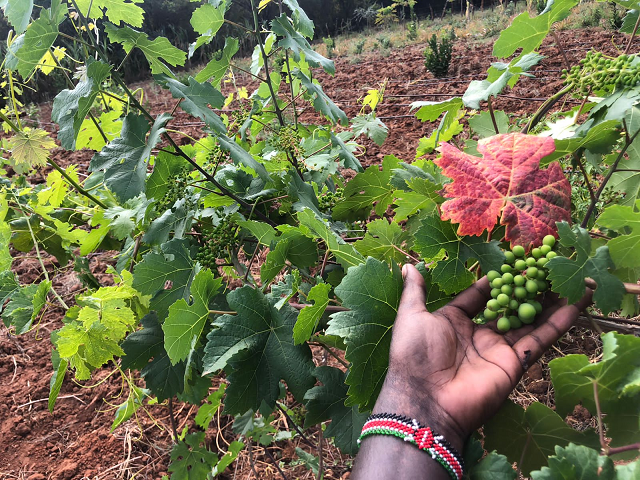
grape Cluster
- Training and pruning
To increase productivity, your grapevines should be well trained and pruned. The mode of training and pruning is determined by the growth habits of your vine. You should exercise much care and precision when pruning. Poor pruning or lack of it leads to poor fruit set. Do more research to up your pruning skills; there are many videos online that will expose you to the different types of training and pruning grapevines.
- Pest and diseases
Ensure you implement plant protection measures to ensure your vines are free from pests and diseases.
The major diseases affecting grapes are;
- Powdery mildew
- Downy mildew
- Anthracnose
Major pests include;
- Thrips
- Mealy bugs
- Leaf hoppers
- Harvesting
Grapes hardly ripen off the tree, so it is proper to harvest them only after ripening. Grape berries kept at room temperature can last a week without spoilage. Different varieties fruit at different time therefore with proper planning and timing you can consume your home grown grapes for the better part of the year. Keep planting!
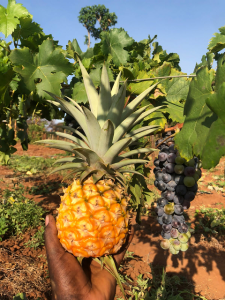
Grape & Pine apple harvest-West Pokot County


 Natural Green Movement